Latest news
Remembering Sir Samuel Morton Peto at Pembury
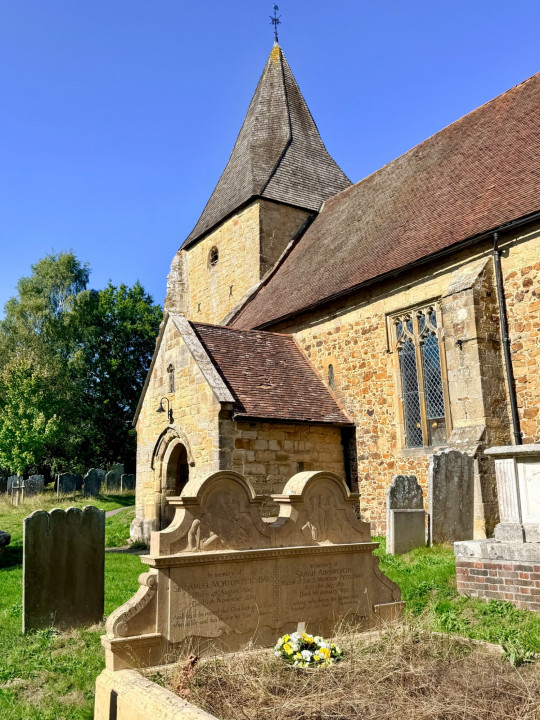
On Friday 25 September, Simon, Laurence and Joe 'Carpet' travelled to Pembury in Kent to honour the man who built our church.
Every time we walk through the doors at 235 Shaftesbury Avenue, we're walking into Samuel Morton Peto's vision. In 1848 he built a Baptist chapel on the edge of St Giles, somewhere Baptists could be seen, and he brought William Brock from Norwich to be its first minister. Nearly 137 years after his death, three of us from the church went to visit his grave.
Peto is buried with his wife, Sarah, in the churchyard of the Old Church of St Peter, Pembury, a little outside the village. The lych-gate is also his memorial. We laid a wreath on behalf of the church, and Simon shared these words and this prayer.
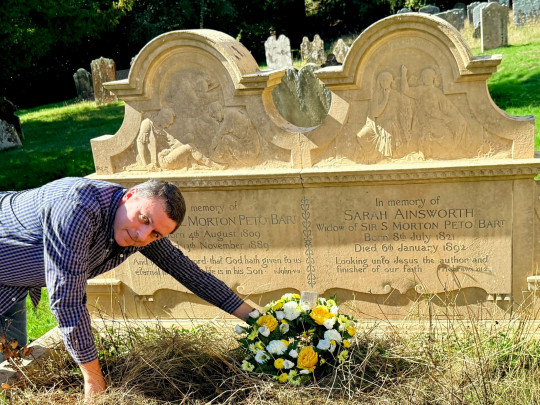
At the graveside
We've come to spend a few moments at the grave of Sir Samuel Morton Peto, who died on 13 November 1889, aged eighty, and lies here with his wife, Sarah.
In his day he was one of the great builders of Britain. His firm built Nelson's Column and much of the new Houses of Parliament. His railways ran across this country and across Canada, and in the Crimean winter of 1855 he built a line from Balaklava up to the siege lines before Sevastopol to supply the troops. At his height he was said to be the largest employer of labour in the world, and he paid out of his own pocket for preachers and teachers to work among his navvies, some of them teaching the men to read.
He was also a Baptist who wanted his faith to be seen. In 1848 he built a chapel on the edge of St Giles, and when the Crown's commissioner worried that dissenters would put up something plain, Peto told him, "A spire, my Lord? We shall have two!" That chapel is Bloomsbury Central Baptist Church, where the three of us work today. He also gave Folkestone a Baptist chapel, which now carries his name over the door of a Wetherspoon's – a reminder that the works of our hands don't always end up where we'd expect.
His life wasn't all triumph. When his bank collapsed in 1866 he was bankrupted, and he lived his last years away from public life, bearing it, people said, with grace. In Parliament he'd fought for Nonconformists to be buried in parish churchyards by their own ministers. And here he lies in an Anglican churchyard, with a Baptist and two Catholics come to lay a wreath. I think he'd have liked that.
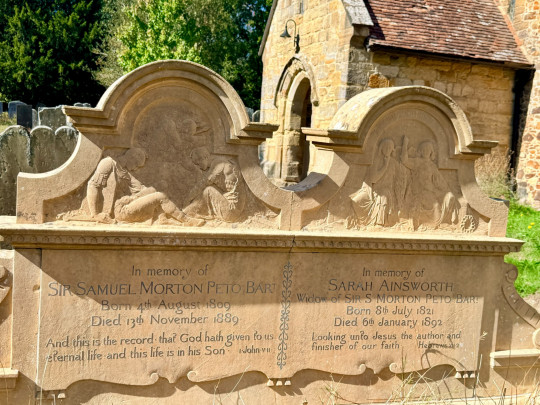
His headstone doesn't list what he built. Instead it carries a verse from the First Letter of John: "And this is the record, that God hath given to us eternal life, and this life is in his Son." For a man whose name is on columns, bridges and railways, it's striking that this is the record he chose. That's where our prayer begins.
The prayer
Living God, whose Son worked as a carpenter and builder in Nazareth, we stand in this quiet churchyard to give thanks.
We thank you for Samuel Morton Peto: for his energy and imagination, and for the faith that moved him to build places where your people could gather and be seen. We thank you for the church in Bloomsbury, still standing and still open on the street he chose. We thank you for Sarah, who lies beside him, and for all who loved them both.
We remember, too, the thousands whose names aren't carved on any stone: the bricklayers, carpenters and navvies whose hands raised his columns, laid his lines and built our church. Their labour was precious to you, and we honour it today.
We give thanks for all that was good in his life, and we entrust to your mercy all that was unfinished or fell short, knowing that his worth, like ours, never rested on success.
On this stone is written the record that matters most: that you have given us eternal life, and that this life is in your Son. So we lay this wreath not in the shadow of death but in the light of that gift. We commend Samuel and Sarah to your love, from which neither death nor life can separate us, and we hold them with all your saints in the communion of your Church, where all are one in Christ.
And we give thanks that we too stand on the only foundation that lasts, Jesus Christ, in whose name we pray. Amen.
The carvings on the grave
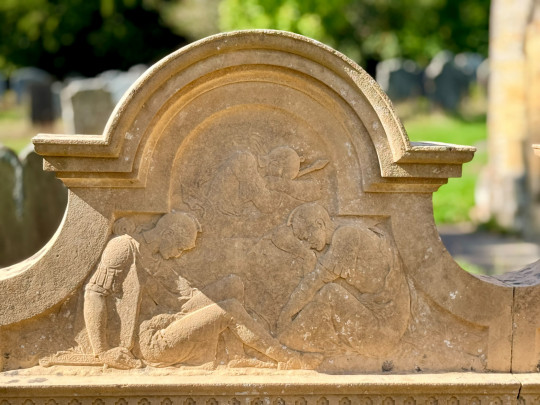
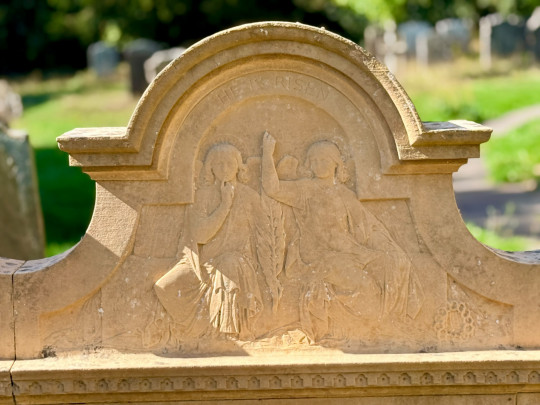
Above the names are two carved panels. Read together, they tell the story of Easter morning.
Above Samuel, two Roman soldiers in helmets and armour sit slumped at the tomb, heads sunk on their arms, fast asleep. A sword lies on the ground beside them, and a third, fainter soldier with a spear dozes above them. These are the guards Pilate sent to make the tomb "as sure as ye can" (Matthew 27.65). The power of Rome, with its sealed stone and armed watch, lies sleeping.
Above Sarah, beneath the words "He is risen", sit two winged angels. One raises a finger to its lips, as if hushed by wonder, and holds a palm branch, the ancient sign of victory, in its other hand. The second angel points upwards to the words themselves. Beside them is a wreath, the crown of life.
The official heritage listing calls the figures above Samuel "mourning figures in classical robes". Look closely, though, and they're plainly soldiers. Read from left to right, the stone moves from the guarded tomb to the empty one: the powers that stand guard over death asleep on one side, and the news of resurrection on the other.
Beneath the carvings are the couple's two texts. For Samuel: "And this is the record, that God hath given to us eternal life, and this life is in his Son" (1 John 5.11). For Sarah, who died two years after him: "Looking unto Jesus the author and finisher of our faith" (Hebrews 12.2). It isn't a stone about what Peto built. It's about the life that's given to us in Christ.
A welcome at Pembury Baptist Church
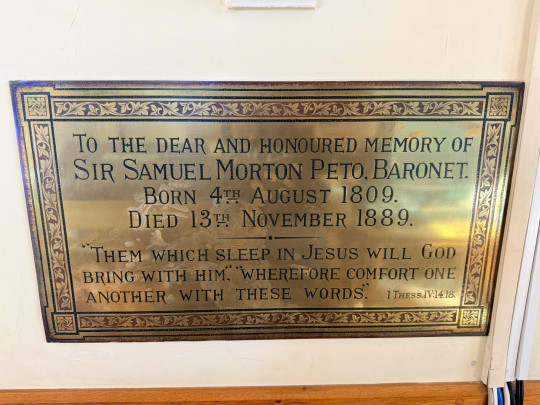
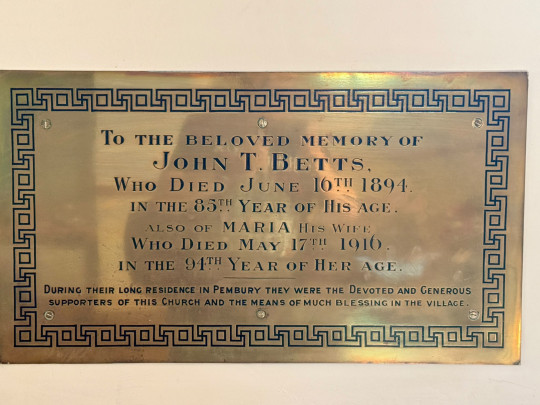
Afterwards we walked into the village to Pembury Baptist Church, where their minister, Dan, welcomed us with sausage rolls and a cup of tea. Peto was a trustee of the chapel and helped bring about its rebuilding in 1887, just two years before he died. Inside we found a brass plaque to his memory, which none of us knew was there. Beside it is a memorial to John Betts, who with his wife Maria did so much for the chapel and the village. The Betts family story is woven through Peto's own: his brother-in-law Edward Ladd Betts was his partner in building railways from Canada to the Crimea. Our thanks go to Dan and everyone at Pembury for making us so welcome.
What Peto built
Peto started out as an apprentice to his uncle, a builder, and ended up building on four continents. Nobody has ever made a complete list of his work, but here's a flavour.
Churches and chapels
- Bloomsbury Chapel (1848). He had the vision, paid for it, chose the site and brought William Brock as its first minister. He also served as a deacon and funded the Bloomsbury mission hall and day school.
- Regent's Park Chapel (1855). He turned the old Diorama in Park Square East into a Baptist chapel, which it remained until 1922. The lane beside it is still called Peto Place.
- A Baptist chapel in Notting Hill, the third of "his" London chapels.
- The nonconformist chapel at Somerleyton, Suffolk, built for the village on his estate.
- St Mary's parish church, Somerleyton, which he had rebuilt in 1854. There's a memorial to him inside.
- St John's Church, Lowestoft (1854), which he paid for as the church of his new seaside resort. It was demolished in 1978.
- The Baptist chapel in Rendezvous Street, Folkestone (1874). It's said to have been his gift, and it's now The Samuel Peto, a Wetherspoon's.
Other church connections
- He worshipped at St Mary's Baptist, Norwich, and at Devonshire Square Baptist in London.
- He laid the foundation stone of Spurgeon's Metropolitan Tabernacle in 1859.
- He was a trustee of Pembury Baptist Church.
- He helped Stepney College, now Regent's Park College, move to Regent's Park.
- He was treasurer of the Baptist Missionary Society and chairman of the Dissenting Deputies.
In London
- The Houses of Parliament, including the river front, the Lords and Commons chambers, the Central Hall, the Royal Gallery and St Stephen's Hall
- Nelson's Column
- The Reform Club, the Conservative Club and the Oxford and Cambridge Club
- The Lyceum, St James's and Olympic theatres
- Hungerford Market
- Great stretches of London's sewers
- Victoria Docks and the Woolwich dry dock
- His own house at 12A Kensington Palace Gardens, now the Embassy of Nepal
- The statue of Sir Hugh Myddelton on Islington Green, which he paid for
Suffolk
- Somerleyton Hall and its model village and school
- Lowestoft harbour and fish market
- Lowestoft's sea wall and esplanade, the Royal Hotel, Marine Parade and Wellington Terrace
Railways and bridges
- Stations at Curzon Street in Birmingham, Paddington and Reading
- The Wharncliffe Viaduct at Hanwell and the Folkestone viaduct
- Victoria Bridge over the St Lawrence in Montreal
- Main lines across Britain, including the Great Western, the South Eastern, the Norwich and Lowestoft, the London, Tilbury and Southend, and the London, Chatham and Dover
- Lines in Canada, Denmark, Norway, France, Algeria, Argentina, Russia, Bulgaria, Germany and Australia
- The Crimean railway from Balaklava to the lines before Sevastopol in 1855
Most of those buildings carry someone else's name, and many of the railways have long since been absorbed into other networks. The chapel he built on the edge of St Giles is still open, still welcoming all who follow Christ, and still here for the people of the West End. We're grateful to have inherited it.
Join us for worship each Sunday at 11am
in our beautiful building on Shaftesbury Avenue
and online at https://us02web.zoom.us/j/215699933
Meeting ID: 215 699 933
Catch up on previous services via our YouTube Playlist